

There is no such thing as a European e-commerce strategy that works the same everywhere. International growth in 2026 will require tough choices, local adaptation, and a deep understanding of consumer behavior, especially now that technology and AI are fundamentally changing the customer journey. Andreas Giese of Dexport, an agency celebrating its 20th anniversary this year by helping brands across borders, sees that brands will have to radically revise their approach in Germany this year. Not only because of the impact of AI, but mainly because purchasing behavior is changing, new legislation is on the way, and Germany works fundamentally differently from other European markets.
Where French consumers are sensitive to brand narrative and heritage, and Spanish shoppers are more likely to make impulse purchases via social commerce and price promotions, German online shoppers are rational, comparative, and strongly focused on certainty. For brands looking to scale up here, success revolves around balance: AI as a lever for scale and efficiency, combined with authenticity and human emotion to build local trust and sustainable growth.
Anyone who wants to seriously scale up in European e-commerce in 2026 cannot ignore Germany. Together with Austria and Switzerland, the country forms the DACH region, by far the largest online market in Europe. This region combines scale with stability and high purchasing power. But more important than size is the character of the German consumer. They are rational, price-conscious, and loyal. Purchases are not made impulsively, but are carefully considered. Trust is not a side issue, but a prerequisite.
This requires a different approach than in many other European markets. One-size-fits-all campaigns, generic content, or standard web shops do not work here. Localization means more than translation: it requires cultural alignment in tone of voice, image use, content formats, and legal structure.
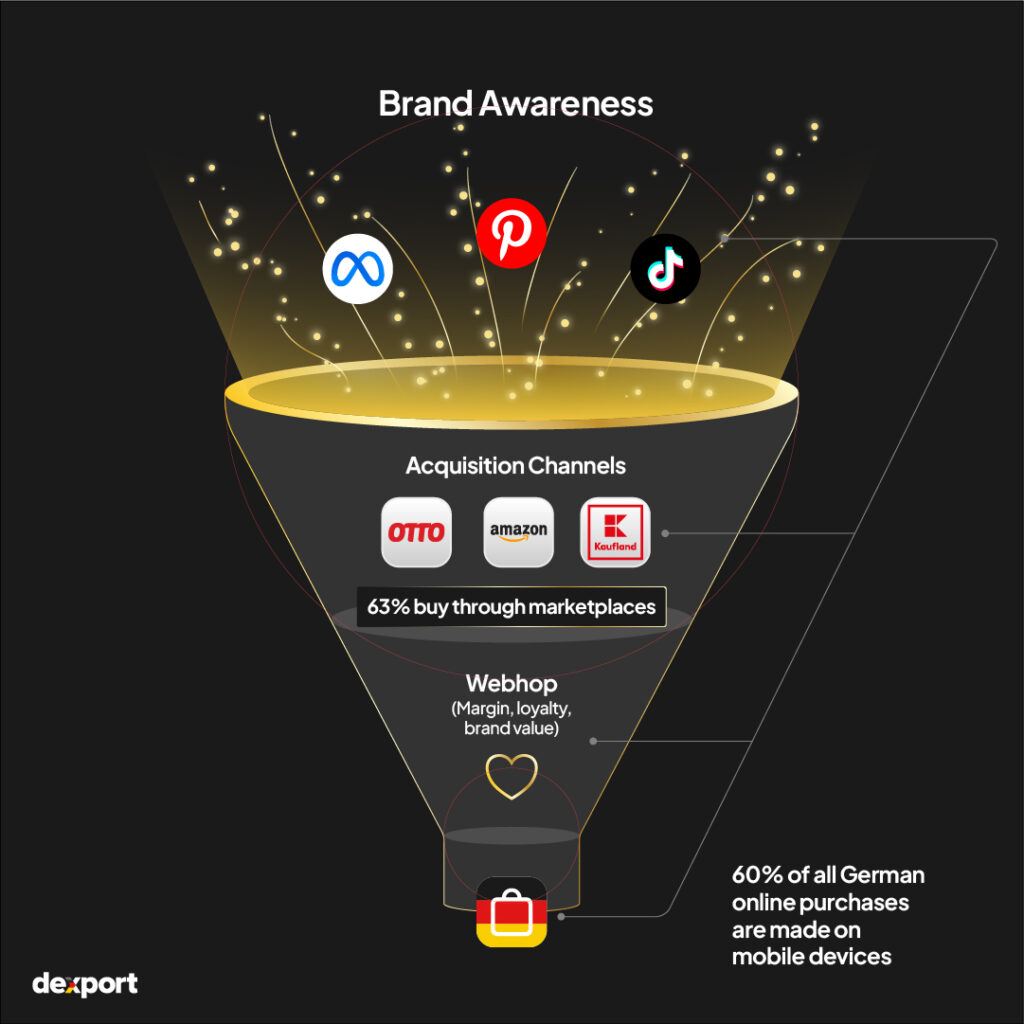
In Germany, marketing budgets are clearly shifting toward social media. Approximately 70 percent of German marketing decision-makers indicate that they are investing more in this area, while traditional channels such as print and TV continue to lose ground. Social platforms are increasingly serving as the discovery layer of e-commerce, especially for Gen Z and millennials.
For brands, this means that social media forms the beginning of the funnel. Not with slick campaigns or exaggerated claims, but with content that is credible and recognizable. German consumers are critical of perfect AI images and marketing language that sounds too good to be true.
That is precisely why user-generated content performs so well. UGC shows real people in real situations and acts as social proof. It lowers the threshold of trust and aligns with the rational mindset of German consumers, who first seek proof and only then allow emotion to come into play.
The next step in the funnel is customer acquisition via marketplaces. In Germany, approximately 63 percent of consumers shop via platforms such as Amazon, OTTO, and Kaufland. These marketplaces are not only sales channels, but also established trusted brands.
For brands entering the German market, marketplaces offer clear advantages:
At the same time, the limitations are clear. Margins are under pressure and there is limited scope for brand storytelling. Branding remains secondary to performance. That is why marketplaces must be used strategically as an acquisition channel and learning engine, not as a final destination.
The webshop as a place for margin, loyalty, and brand deepening
The company's own webshop remains essential, but will play a different role in 2026 than it did before. No longer as the first touchpoint, but as a place where margin, repeat purchases, and brand loyalty are achieved. There is one strict prerequisite: mobile first.
In Germany, around 60 percent of all online purchases are now made via mobile devices. Any online store that is not equipped for this will immediately lose conversions. But technology alone is not enough. Trust remains the decisive factor.
German consumers are explicitly wary of:
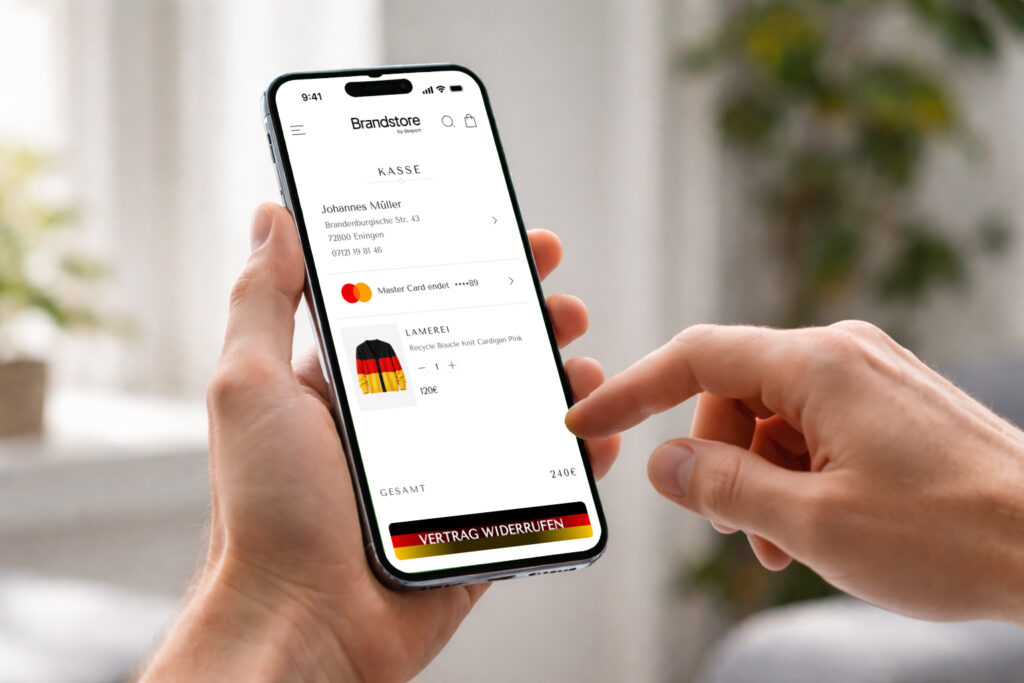
Important: From June 19, 2026, a new legal obligation will be added: the Widerrufsbutton ("Vertrag widerrufen") in the customer portal. Failure to comply not only poses a legal risk, but also a direct loss of conversion for consumers who expect certainty.
AI is playing an increasingly important role in cross-border e-commerce. It speeds up translations, content production, ad creation, and feed optimization. At the same time, visibility is shifting to AI-driven interfaces, in which large language models and shopping agents compare products based on data.
This makes structured data and rich product feeds essential. Attributes related to safety, sustainability, and origin, linked to EAN or GTIN codes, determine whether a brand is even mentioned in AI responses. Brands with incomplete or inconsistent data disappear from view, regardless of their marketing budget.
But in Germany, there is a clear warning: AI only works if it supports authenticity. Over-optimized texts and generic visuals actually undermine the trust of critical consumers.
5. Google AI Mode & SEO
With the arrival of Google AI Mode, SEO is shifting from findability to quality of answers. Google is increasingly acting as a conversational assistant that breaks down multi-step questions, combines sources, and actively reaches a conclusion. Whereas AI Overviews mainly summarize, AI Mode focuses on comparison and decision-making, precisely the stages in which German consumers are particularly critical.
For brands, this means that optimizing for individual keywords is no longer sufficient. In AI Mode, brands are assessed as sources of knowledge. Only parties with clear expertise, consistent positioning, and well-structured content are included in the answer. Google's role is also changing commercially: advertisements are shifting from keywords to context and intent, with recommendations and product selections directly in AI answers by 2026.
In 2026, Germany will show where European e-commerce is heading: more strictly regulated, more strongly driven by data and AI, but at the same time less forgiving for brands that underestimate consumer trust. Success here is not just about scale, but about precision: local relevance, legally sound foundations, and a sharp balance between technology and humanity. AI acts as an indispensable growth accelerator for visibility and efficiency, but in Germany it only pays off when authenticity and transparency remain paramount. Marketplaces accelerate acquisition, social media builds trust, and your own webshop capitalizes on loyalty and margin. Brands that consciously separate these roles and consistently align their data, content, and brand story create a sustainable competitive advantage. This makes Germany not a difficult market, but a litmus test: those who are successful here lay a solid foundation for scalable growth in the rest of Europe.


