
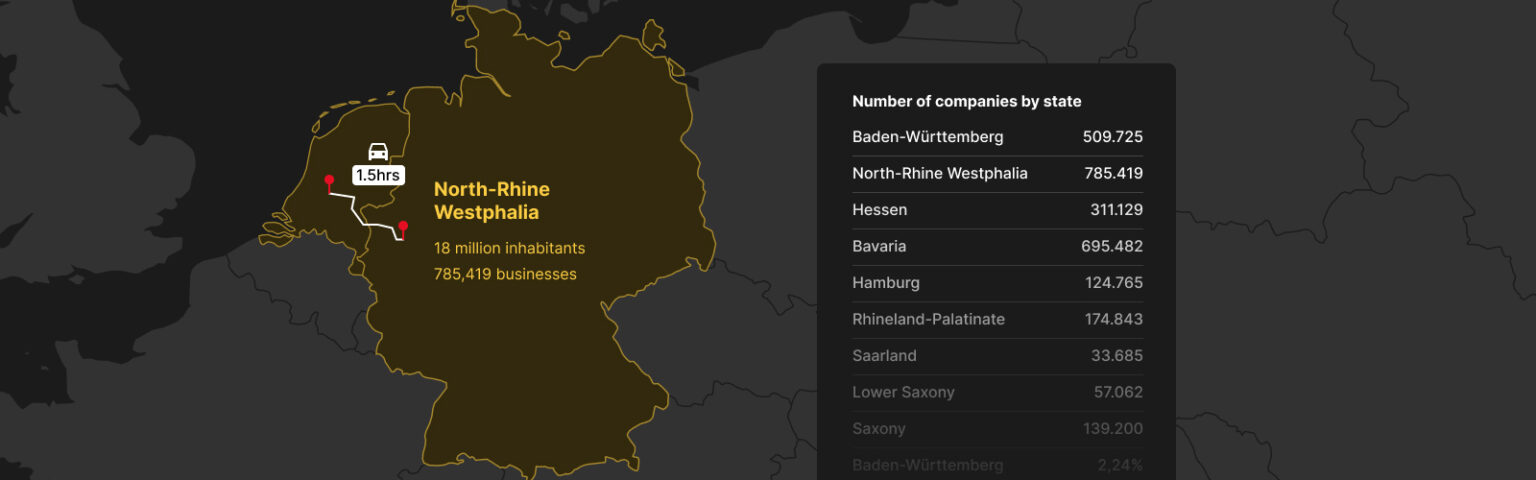

If you want to build B2B market share outside the Netherlands, Germany is the most logical step. The German market with 5 million companies is huge. And close. From the middle of the Netherlands, you can be in North Rhine-Westphalia (NRW) in 1.5 hours. This economic powerhouse has 18 million inhabitants, 700,000 companies and as many as 75,000 medium-sized enterprises (50-250 employees). So a logical first step for Dutch companies with German ambitions.
Still, as an outsider, it is difficult to gain immediate trust. Therefore, a simple advertisement or cold call attempt often backfires. Success in the German B2B market is all about strategy, preparation and... consent.
In Germany, everything is about trust. And you don't win trust with English or half-translated promotional material. German decision-makers expect a professional, local approach - right down to the last detail. That means a German-language website with a correct Impressum and Datenschutz, a German phone number, a local business address and - if you really want to be seen as a German company - a GmbH. Only when these basics are right can you effectively invest in marketing and sales. Otherwise, your offer will soon feel "foreign" and you will be missing out on leads before your funnel even starts. As the Germans themselves say, "Dienst ist Dienst und Schnaps ist Schnaps" - in other words, business is business, and you do it according to their rules. At Dexport, we help you do just that. From legal localization to native communication and credible positioning, so that your message arrives and convinces.
Whether you want to reach category managers, buyers or directors - direct contact remains effective. Think of calling, emailing or sending a sample. However, in Germany you are not allowed to just call or e-mail companies. You may not even just send a commercial LinkedIin message,. Unsolicited outreach can result in an Abmahnung - a legal warning that comes with immediate costs of €500 to €1,500, and often includes a contract promising never to contact the company again. If you later do so anyway (even accidentally), you risk fines that can amount to tens of thousands of euros. The German telecom authority (Bundesnetzagentur) can also impose high fines for unauthorized telephone contact. What is allowed? Retargeting through advertisements (with permission), personal contact via LinkedIn or Xing (if based on consent), physical direct mail (without opt-in), or building relationships via trade shows and events. In short: successful B2B outreach in Germany requires strategy, diligence and respect for the law.
The most logical first step in B2B marketing is to be findable on the right keywords. But in Germany, those keywords can vary greatly by region and target group - for example, people in Bavaria search for "Pferdebox," while in northern Germany "Pferdestall" is more common. Moreover, behind those terms there are different target groups: consumers, small businesses or, on the contrary, large corporate buyers. Therefore, it is crucial to determine in advance who you really want to reach. Use tools to identify the most valuable segments, so you don't waste your budget on irrelevant visitors and can retarget those with the highest conversion probability.
You then reach your target group via both LinkedIn and Xing. Whereas LinkedIn is internationally dominant, Xing remains the market leader within the DACH region with 21 million members (Statista, 2024), especially in target groups such as HR, sales, IT and engineering. Both platforms offer extensive segmentation options by job title, industry, company size and region. Combine that with quality content - video in particular performs well - and you not only build authority, but also increase the effectiveness of your search and retargeting campaigns. Make sure your traffic lands on an optimized page where you can immediately ask permission for follow-up steps via e-mail or social. And as an organization, clearly define what outreach you do and don't use. While trade shows are still valuable for relationship building, keyword campaigns and social media offer a scalable alternative.
Did you know that German companies are increasingly making purchases online? B2B e-commerce is set to grow by more than 15% in the coming years. Platforms such as Wer liefert was, Mercateo, and Amazon Business are being used more and more by buyers, category managers, and departments that need to act quickly.
Make sure you’re visible on these platforms—with accurate product data, clear pricing, and all legal documents in order.
Do you want to be smarter about it?
At Dexport, we’ve developed a full-funnel approach to set up this entire process in a scalable and legally compliant way. From segmentation and targeting to outreach via our Global LeadEngine: a combination of ads, email, LinkedIn, and smart follow-up.
B2B marketing in Germany works—if you do it right.
Want to know what works for your company? Or are you curious about what a lead should cost you in your industry? Let us know. We’d be happy to calculate it for you.