
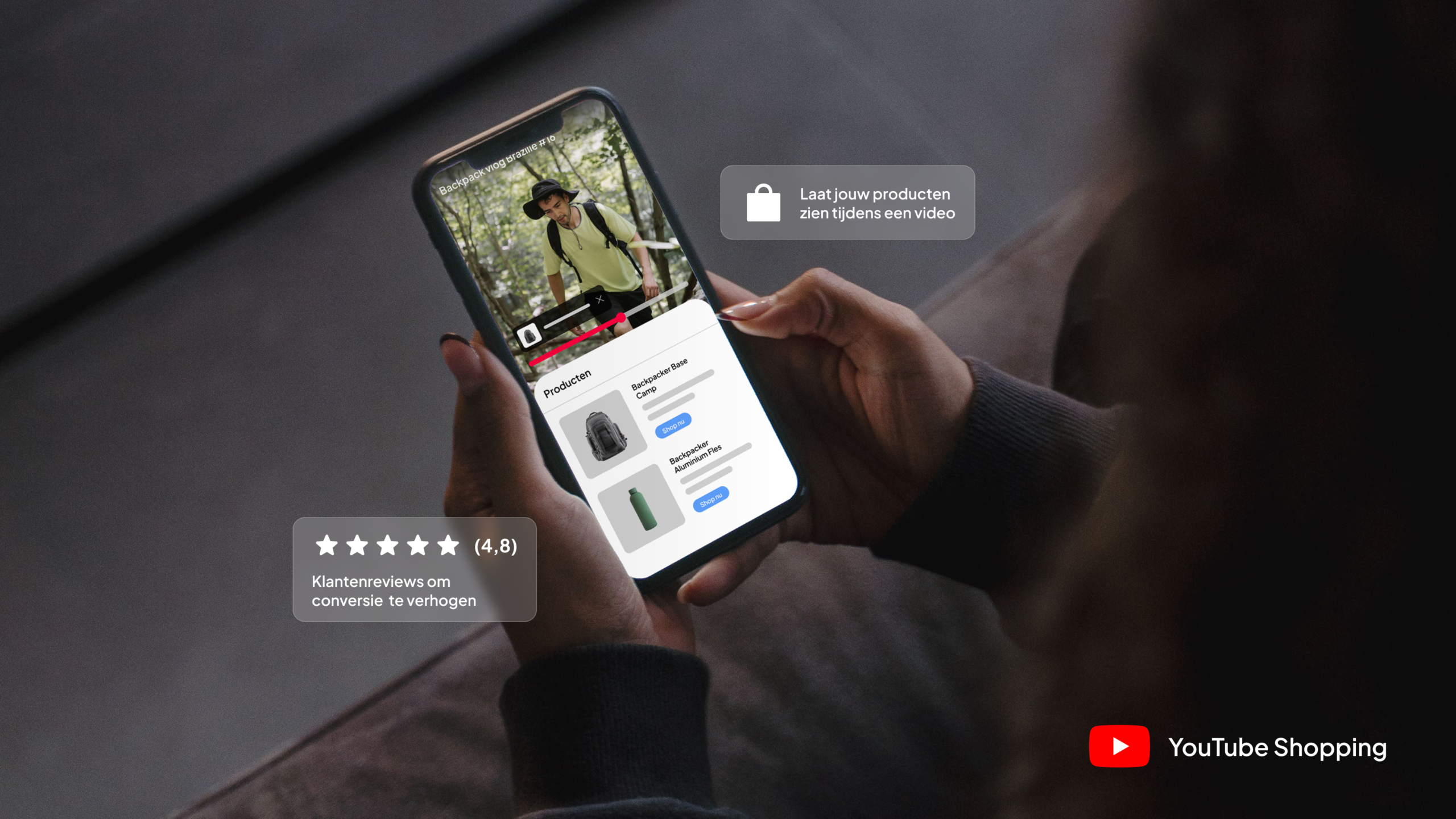

YouTube Shopping has been available in Germany since September 2026. For Dutch brands looking to grow in the German market, this represents a significant commercial opportunity: product discovery, creator content, advertising, and sales all come together on a single platform.
The customer journey of German consumers is changing. People no longer search for products solely through Google or a marketplace. Consumers discover brands through Shorts, read reviews and product tests, compare alternatives, and seek advice from creators. As a result, content plays an increasingly important role during both the research phase and the final purchase decision.
The German YouTube market is large. Google’s advertising data shows that, as of early 2025, YouTube had a potential advertising reach of 65.5 million users in Germany. That corresponds to approximately 83% of all German internet users. This figure refers to potential advertising reach and not necessarily the number of monthly active users. YouTube Shopping now adds a direct commercial link to that.
German viewers now consider YouTube the most important video platform when they are researching, evaluating, or considering the purchase of a brand, product, or service. YouTube outperformed television, Instagram, TikTok, Facebook, Netflix, and Amazon Prime Video, among others.
YouTube Shopping makes it possible to link products directly to videos, Shorts, and livestreams. Viewers can discover a product while watching, access additional information, and then click through to the retailer’s online store.
Participating retailers make their product catalogs available through Google Merchant Center. The product data is automatically synced. Creators can then select relevant products and link them to their content.
For brands, there are two main approaches:
When the Shopping Affiliate Program was launched in Germany, OTTO, MediaMarktSaturn, Kaufland, ABOUT YOU, Shop Apotheke, Tchibo, bonprix, Home24, Thalia, and XXXLutz, among others, joined the program. The network of participating retailers is continuing to expand.
Dexport is a (premier) partner of Google, OTTO, and Kaufland, among others. This allows us to provide additional support to clients when integration with these marketplaces is relevant to their German e-commerce strategy.
YouTube Shopping combines creator marketing, affiliate marketing, and performance advertising. Retailers can track which content and creators generate product clicks and conversions. High-performing creator videos can then be scaled up further through paid media campaigns.
This results in an integrated approach:
In a global internal experiment, YouTube reported that videos with product tags generated more than 110% more product clicks than videos that used only links in the description. While this isn’t a guarantee for every brand, it does show how much a direct product tag can reduce conversion friction.
Products that require an explanation, demonstration, or comparison can benefit from this the most. Examples include electronics, furniture, cosmetics, fashion, sporting goods, and home and garden products. Unboxing videos, tutorials, product reviews, comparisons, and try-on hauls help consumers understand the product and build trust before they make a purchase.
For a new German YouTube channel, we recommend a full-funnel approach in which organic content, creators, advertising, email marketing, and the existing customer base reinforce one another.
A Dutch content concept doesn't automatically work in Germany. First, research which questions, objections, search terms, competitors, and purchasing criteria are relevant to the German target audience.
Based on that, we determine:
A sales-oriented channel isn't made up solely of product videos. The content must align with the different stages of the customer journey:
This way, you not only build your reach, but you also guide German consumers step by step toward a purchase.
Shorts can quickly generate reach and attract new subscribers. Longer videos are ideal for in-depth content, product comparisons, and explanations. The combination is key: Shorts grab attention, while long-form content builds trust and purchase intent.
A comprehensive product video can also be adapted into multiple short formats for YouTube Shorts and other social media channels. This turns a single strong topic into a broader content campaign.
A new German channel doesn't have to start from scratch. Existing customers, newsletter subscribers, and website visitors can be leveraged to build an initial audience of relevant viewers and subscribers.
Consider:
This ensures an initial audience that is already interested in the brand or product.
The widest reach doesn't always come from the biggest creator. Smaller, specialized creators often have an engaged audience and a strong connection to a specific product category.
Therefore, don't select creators based solely on the number of followers, but also on:
By making creator content measurable, the budget can then be redirected toward the videos and collaborations that actually deliver results.
Organic channel growth takes time. With YouTube Advertising, high-quality videos can reach relevant German audiences more quickly.
In doing so, various target groups can be identified:
This way, YouTube becomes part of a single, integrated marketing strategy, rather than a standalone content channel.
Meta and Instagram can be used to distribute YouTube content to relevant German audiences:
This is how Meta and YouTube reinforce each other within the German customer journey: Meta provides additional reach and repeated touchpoints, while YouTube offers deeper engagement, trust, and product orientation.
The most significant change isn't just that products can be tagged in videos. YouTube is bringing search, inspiration, creator trust, advertising, and purchasing increasingly closer together.
This is in line with Alphabet’s broader strategy. Google is increasingly integrating Search, Gemini, Merchant Center, ads, and YouTube with commerce. As a result, product data is becoming more important at every stage of the customer journey: from traditional search results and AI-powered answers to video, product recommendations, and ultimately the purchase.
For brands, this means their German marketing can no longer be organized on a per-channel basis. Product feeds, content, SEO, GEO, creators, Google, YouTube, Meta, retargeting, and conversion optimization must be aligned both in terms of content and technology.
For brands, this means that their German marketing can no longer be organized on a channel-by-channel basis. Product feeds, content, SEO, GEO, creators, advertising, and conversion optimization must be aligned both in terms of content and technology.
As a result, a YouTube video can simultaneously:
The number of subscribers is important, but it shouldn't be the only KPI. A business YouTube channel should contribute to reach, brand preference, and sales.
Key KPIs include:
By analyzing these results on a regular basis, it becomes clear which topics, formats, creators, and products should be scaled up further.
YouTube Shopping offers Dutch brands a new opportunity to reach German consumers earlier in the customer journey and bridge the gap between inspiration and purchase. However, success requires more than just enabling product tags. A profitable YouTube channel is built by combining knowledge of the German market, a distinctive positioning, relevant content, creator partnerships, a high-quality product feed, and data-driven advertising.
Dexport helps brands develop and implement this integrated approach.